
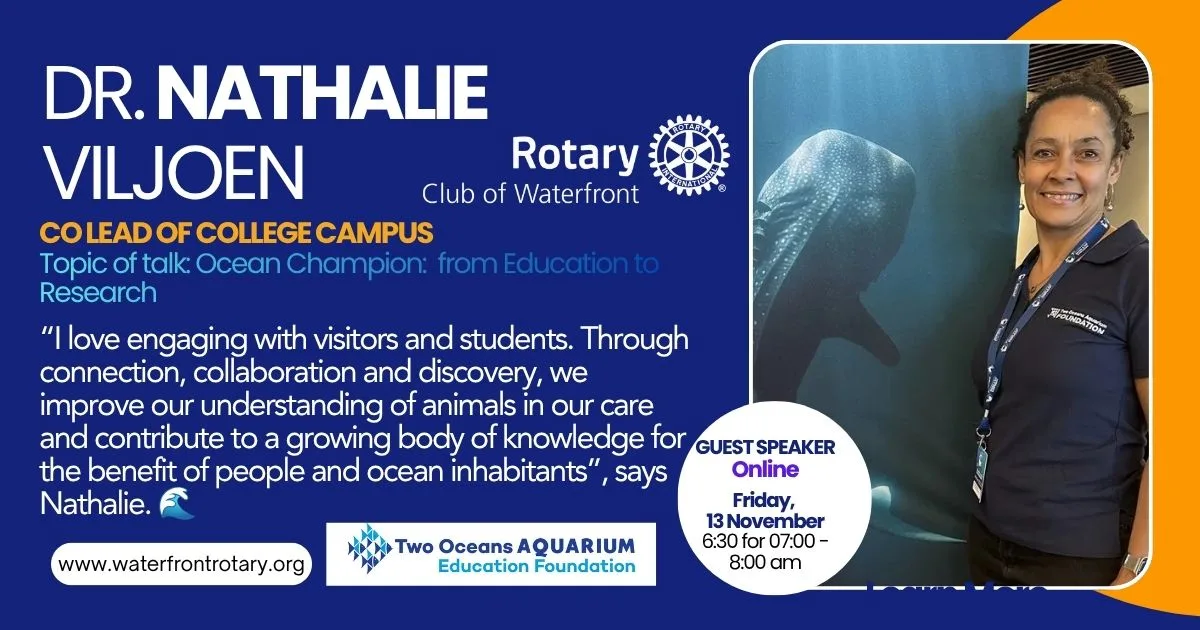
For Nathalie, a passion for the ocean began long before her career in marine research. She shared how childhood holidays in Mossel Bay, spent alongside her father, an enthusiastic fisherman, helped nurture her fascination with marine life and the ocean.
During her presentation to the Rotary Club of Waterfront, Nathalie took members through her impressive academic journey, culminating in the award of her PhD from the University of Limpopo in 2009. She also shared insights into her professional journey and the research and conservation work she has been involved in over the years.
From Education to Marine Research
Since joining the Two Oceans Aquarium Foundation in 2018, Nathalie has held two roles, progressing from Head of Research to Co-Lead of College Campus. Her work has evolved from a focus on education to a stronger emphasis on research and conservation.
The Two Oceans Aquarium, owned by the V&A Waterfront, established the Two Oceans Aquarium Foundation in 2020. Since 2021, the Foundation has operated as a Public Benefit Organisation (PBO), focusing on research and working in collaboration with funders.
Nathalie provided an overview of the Foundation’s research portfolio, highlighting the scale and diversity of its work. To date, 101 research projects have reportedly been undertaken, with approximately 50 currently active.
Among the projects she discussed were turtle conservation and research into ragged-tooth sharks. One particularly fascinating example involved sharks being kept in captivity for approximately eight years before being tagged and released. Researchers then track their movements to understand their migration patterns and compare their routes with those of wild populations.
These projects demonstrate how research can contribute to a better understanding of marine species and inform conservation efforts.
Why the Ocean Matters
One of the most impactful parts of Nathalie’s presentation was her exploration of the ocean’s strategic importance to the planet and humanity.
Covering approximately two-thirds of the Earth’s surface, the ocean plays an essential role in regulating the climate, supporting biodiversity, sustaining livelihoods and providing food for billions of people.
Some of the facts she shared highlighted just how much we depend on this vast natural resource:
- Marine biodiversity: South Africa’s coastline is among the most biologically diverse in the world and is home to approximately 15% of the world’s marine biodiversity.
- Coastal communities: Approximately 30% of South Africa’s population, or around 18 million people, live in coastal areas.
- Climate regulation: The ocean absorbs approximately 25% of the carbon dioxide released into the atmosphere and plays a critical role in regulating global temperatures.
- Oxygen production: Marine ecosystems, particularly microscopic organisms such as phytoplankton, contribute significantly to the oxygen produced on Earth.
- Ocean currents: The Benguela and Agulhas current systems play an important role in shaping Southern Africa’s marine environment and influencing regional weather and climate patterns.
- Food security: More than three billion people depend on marine and coastal biodiversity for their livelihoods, while fish and seafood provide an important source of animal protein globally.
- Global trade: More than 90% of global trade by volume is transported by sea, making the ocean indispensable to the world economy.
- The Blue Economy: The global ocean economy is estimated to be worth approximately US$2.5 trillion annually, supporting jobs, industries and economic opportunities around the world.
These figures offered a powerful reminder that the ocean is far more than a natural wonder. It is fundamental to the health of our planet, the sustainability of our communities and the global economy.
Due to space constraints, we have only been able to share a glimpse of Nathalie’s presentation and the fascinating research and conservation projects she is involved in.
Her insights left members with a greater appreciation of the ocean’s importance and the need to understand, protect and sustainably manage its resources.
We sincerely hope Nathalie will join us again in the not-too-distant future to share more about her work and the discoveries being made through marine research.
Thank you, Nathalie, for an engaging and thought-provoking presentation!

